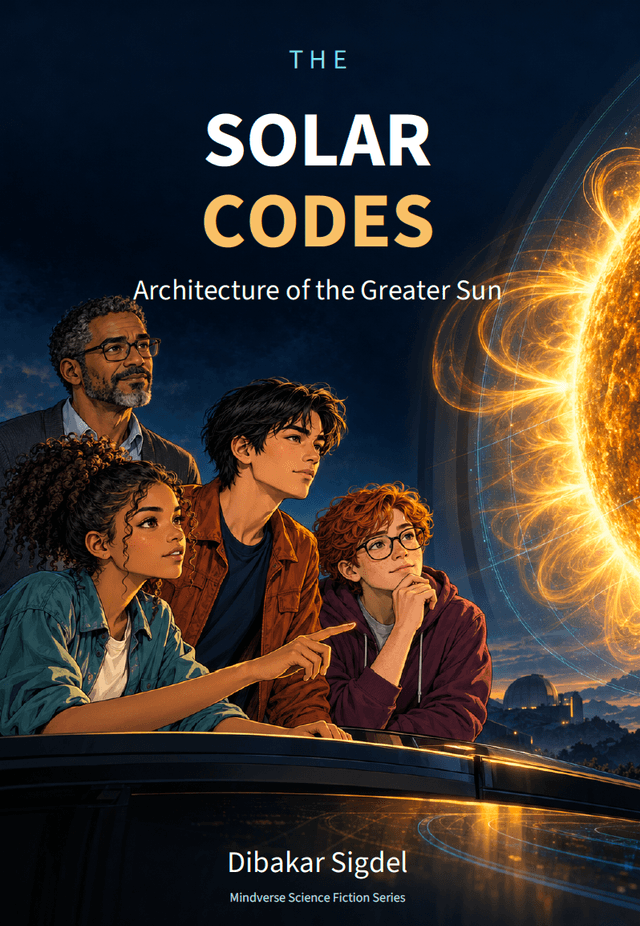
Elena, Kai and Milo arrive at a mountain observatory expecting a summer of instruments, data and ordinary stars. Instead, a persistent pattern leads them toward a question that reaches far beyond the Sun they know.
With observatory director Dr. Vance, the three students follow a trail through stellar remnants, the solar system's formation, and the architecture of living systems. Their investigation grows into the Greater Sun hypothesis: an imagined connection whose elegance makes it difficult to leave alone. But an explanation can be beautiful without being right, and the friends must decide what would count as evidence before the results arrive.
Elena wants a claim she can defend. Kai wants an experiment that works. Milo wants to see a connection nobody has noticed. As their summer project becomes a public exhibition, those ambitions bring them together and pull them apart. To finish what they started, they will need more than a striking picture of the universe. They will need to listen, revise, and risk testing an idea they want to believe.
The Solar Codes: Architecture of the Greater Sun is a speculative science-fiction graphic novel told across ten chapters and 200 illustrated story pages. It combines the wonder of cosmic questions with the human difficulty of admitting uncertainty. The Greater Sun and its imagined intelligence landscapes are fictional possibilities, not claims of established science.
Written for general readers, especially high-school readers and adults, this is a continuous story of curiosity and collaboration rather than a textbook or activity workbook. No age restriction applies.
Genres
Fiction_Science Fiction_GeneralComics and Graphic Novels_General
ISBN
9798907972445
Format
Print / Paperback
Publication Date
October 1, 2026
MSRP
Write for info
Status
Forthcoming
Target Audience
College Audience
Contributors
Mindverse Computing LLC
Produced by
Mindverse Computing LLC is a Washington-based technology company developing an agentic digital twin of the mind, trained on non-invasive brain-computer interface data. Its founding premise is that a personal model of how an individual attends, learns, and rests can make instruction genuinely adaptive in ways generic material cannot, and that the same model applies to meditation practice and mental-health support.
This book comes out of the company's Superlearning research programme, which develops courses and learning materials designed to accelerate learning when paired with AI assistance and a learner's own BCI data. The book stands on its own: nothing in it requires a device, an account or a subscription. It is part of the printed half of that work.
Dibakar Sigdel
Author, Editor
Dibakar Sigdel wrote and edited The Solar Codes. He is a physicist and data scientist whose work centres on brain-computer interfaces and on bringing high-performance and quantum computing to bear on them. At Mindverse Computing LLC, he leads research and development in classical-quantum algorithms and in the Superlearning methodology from which this book grew.