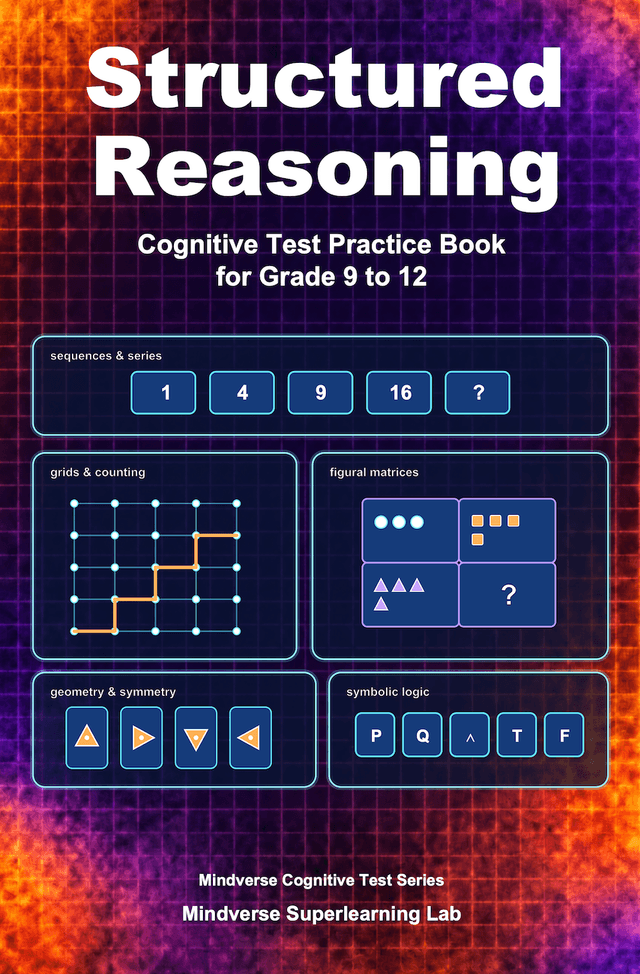
Structured Reasoning is where the answers acquire proofs. It is written for readers roughly fourteen to eighteen, and for anyone preparing for an admissions paper, an aptitude battery or a competition.
The book holds more than 850 original items across six strands - sequences, series and recurrence; grids, constraints and combinatorial structure; geometry, transformation and symmetry; figural matrices; symbolic logic and cryptology; and a full assessment chapter. Every item has five choices and exactly one defensible answer, published with the rule behind it, the derivation, the fast route where one exists, and, where that is the honest professional method, the few lines of code a working mathematician would write.
What distinguishes it from a practice book is that the results are established rather than asserted. Why exactly three regular polygons tile the plane, settled by asking which integers divide four. Why there are exactly five Platonic solids, exactly seven frieze groups, exactly seventeen ways for regular polygons to close a vertex. Eight named proof techniques are indexed at the back, and they are the transferable content of the volume.
It also states how the tests themselves work: the five rule types that generate essentially every published figural matrix, a catalogue of every distractor construction in the book and the reasoning error each exploits, and plain notes on where a published instrument measures something other than what it claims. The research is clear that solvers who know the rule set do measurably better, so withholding it would handicap the reader rather than measure them.
Four distinct assessment regimes - targeted modules, a full-length simulation, an under-timed speed set, and an untimed rigour set - train pacing skills that genuinely conflict. A second part adds six 45-minute papers at three bands.
Genres
EducationMathematics
ISBN
9798907972414
Format
Print / Paperback
Publication Date
September 30, 2026
MSRP
Write for info
Status
Forthcoming
Target Audience
Elementary/High School
Contributors
Mindverse Computing LLC
Produced by
Mindverse Computing LLC is a Washington-based technology company developing an agentic digital twin of the mind, trained on non-invasive brain–computer interface data. Its founding premise is that a personal model of how an individual attends, learns, and rests can make instruction genuinely adaptive in ways generic material cannot, and that the same model applies to meditation practice and mental-health support.
This series comes out of the company’s Superlearning research programme, which develops courses and learning
materials designed to accelerate learning when paired with AI assistance and a learner’s own BCI data. The books stand on their own: nothing in them requires a device, an account or a subscription. They are the printed half of that work
Dibakar Sigdel
Editor
Dibakar Sigdel led and edited this series. He is a physicist and data scientist whose work centres on brain–computer interfaces and on bringing high-performance and quantum computing to bear on them. At Mindverse Computing LLC, he leads research and development in classical–quantum algorithms and in the Superlearning methodology from which this series grew.