Back to search
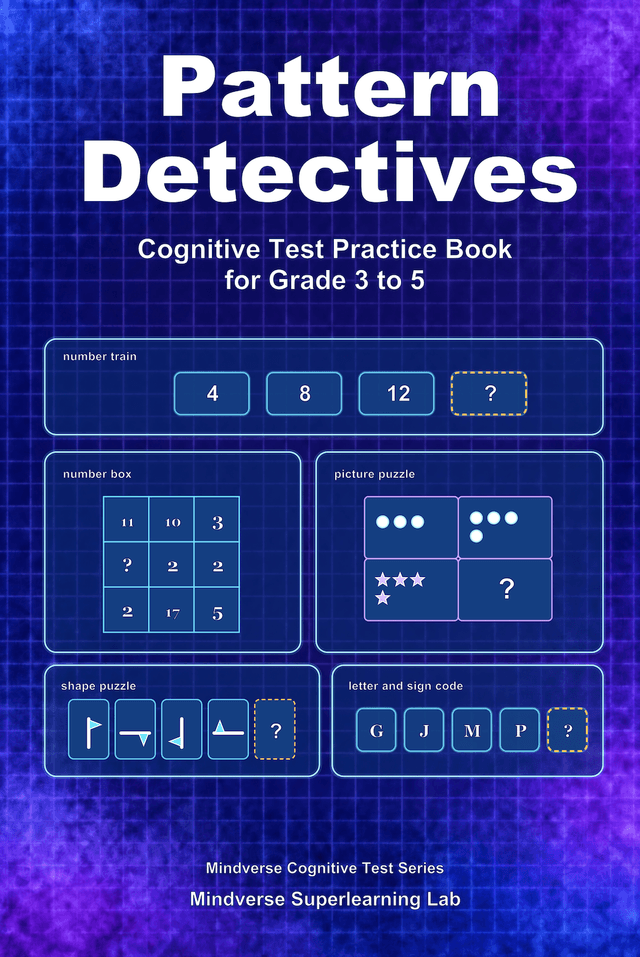
Cover of Pattern Detectives

Pattern Detectives

Cognitive Test Practice Book for Grade 3 to 5

Pattern Detectives teaches children roughly eight to eleven the one habit that makes pattern puzzles solvable: find the rule, say it out loud, test it on a part you can already see, and only then choose an answer. The book includes more than 550 original puzzles across five families: number sequences, number grids, shapes that turn, flip, and fold, picture puzzles in a box, and codes built from letters and signs. Each family has its own colour and its own chapter, so a child always knows what kind of problem is in front of them. Every puzzle offers four choices and has exactly one defensible answer, and the answer pages at the back give the rule behind each one in plain words. Getting an item right by luck and getting it right by rule feel identical at the time, and only one of them helps with the next one. A second part adds six complete practice papers at three levels, with answer sheets meant to be photocopied, so a child can sit a paper, work on whatever the error tally points at, and sit its twin a few weeks later. The book makes no claim that puzzle practice raises general intelligence. What it reliably does is make these formats familiar rather than strange, build fluency, and give a child the vocabulary to describe a rule, which is the part that transfers. A guide for parents and teachers at the back covers what the book does and does not measure, how to pace the practice papers, and what a weak chapter score actually indicates.

Genres

EducationMathematics

ISBN

9798907972391

Format

Print / Paperback

Contributors

Mindverse Computing LLC

Produced by

Mindverse Computing LLC is a Washington-based technology company developing an agentic digital twin of the mind, trained on non-invasive brain–computer interface data. Its founding premise is that a personal model of how an individual attends, learns, and rests can make instruction genuinely adaptive in ways generic material cannot, and that the same model applies to meditation practice and mental-health support. This series comes out of the company’s Superlearning research programme, which develops courses and learning materials designed to accelerate learning when paired with AI assistance and a learner’s own BCI data. The books stand on their own: nothing in them requires a device, an account or a subscription. They are the printed half of that work

Dibakar Sigdel

Editor

Dibakar Sigdel led and edited this series. He is a physicist and data scientist whose work centres on brain–computer interfaces and on bringing high-performance and quantum computing to bear on them. At Mindverse Computing LLC, he leads research and development in classical–quantum algorithms and in the Superlearning methodology from which this series grew.