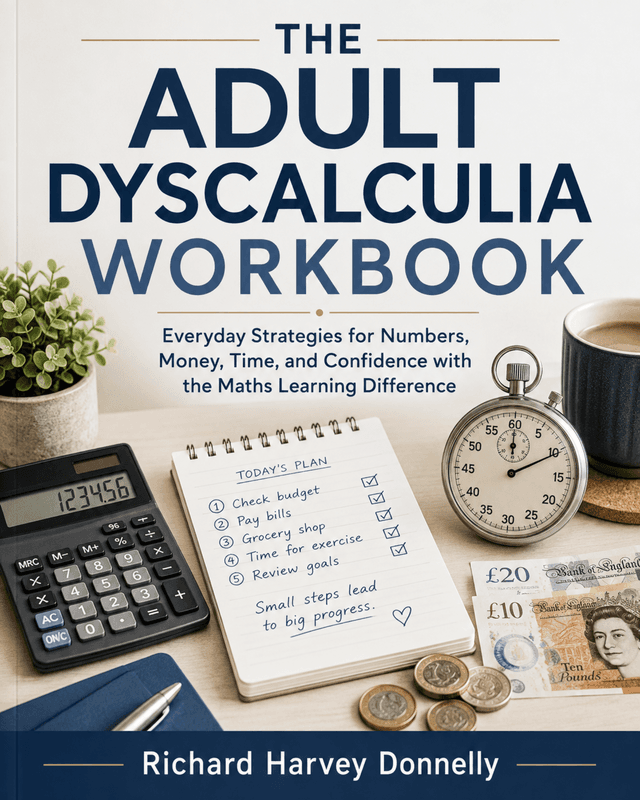
Everyday Strategies for Numbers, Money, Time, and Confidence with the Maths Learning Difference
Numbers should not have to control your day.
Money, time, prices, dates, measurements, travel plans, workplace figures and everyday calculations can become exhausting when numbers do not feel reliable. The Adult Dyscalculia Workbook offers a practical way to reduce that strain by replacing pressure and guesswork with clear systems you can use in ordinary adult life.
Practical support for the numbers you cannot avoid
This workbook helps adults with dyscalculia, suspected dyscalculia, or persistent difficulty with numbers understand how dyscalculia can affect daily tasks and build methods that reduce errors, memory load and number panic. Rather than treating fast mental maths as the goal, the book shows how to use calculators, written steps, visual references, reminders, checking routines and simple planning tools with confidence.
You will work through adult situations involving budgeting, shopping, bills, discounts, appointments, time estimation, household measurements, travel, dates, codes, workplace maths and assistive technology. Each chapter turns a common problem into a practical system, with worksheets, worked examples, checklists and exercises designed for immediate use.
A workbook built around adult life
This is not a school-style maths programme and it does not ask you to prove yourself by doing calculations quickly in your head. The focus is functional independence: deciding what needs to be calculated, what can be estimated, what should be written down, what can be handled by technology, and what needs a second check. The final section brings the book together in a Personal Number Support Manual that you can tailor to your own routines.
Who this book is for
This book is for readers who have diagnosed or suspected dyscalculia; adults who have long described themselves as “bad at maths” but want more useful ways to manage numbers; neurodivergent adults who also live with dyslexia, ADHD or related learning differences; people who experience anxiety around money, time or calculations; and adults who want practical methods for reducing number-related mistakes at home or at work.