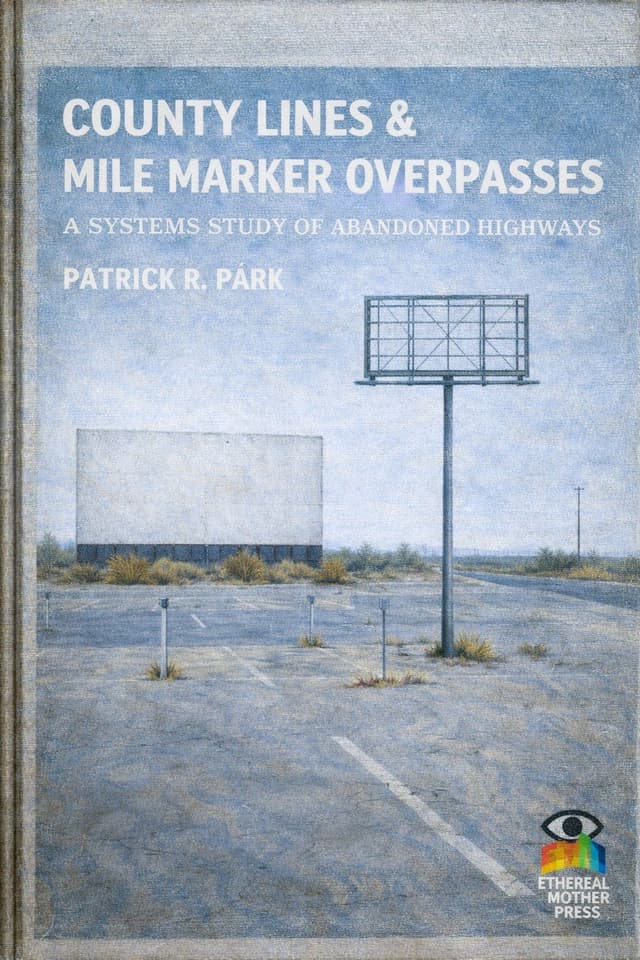
County Lines & Mile Marker Overpasses is a quiet field book about the places where roads pause and people start taking stock of their lives. Set across the back roads, service ramps, and forgotten junctions of the American interior, the book follows a loose sequence of poems and short prose pieces that treat roadside infrastructure as a kind of emotional geography. Overpasses, truck stops, drainage culverts, farm gates, and empty interchanges become markers for the slow, uneasy realization that time has moved further ahead than expected.
Rather than telling a single story, the book drifts through moments: a man standing above an empty interstate at noon, a gas station closing early on the edge of a county line, a winter road where the plow never quite made it to the shoulder. These scenes feel ordinary at first glance, but they carry the quiet weight of middle distance in life—when old ambitions are still visible in the rearview mirror but the road ahead has begun to thin out.
The language stays plainspoken and physical. Concrete, asphalt, steel guardrails, faded mile markers, and wind moving through weeds provide the vocabulary of the book. Movement—once assumed, once automatic—becomes uncertain. Highways built for constant motion sit temporarily empty. Exit ramps appear too late. Long drives that once meant escape now feel like circles.
What emerges is not a political or social argument, but a portrait of midlife recognition: the moment when a person begins to understand the difference between the map they expected and the terrain they actually inhabit.
Yet the book never settles into despair. Even the emptiest roads still run somewhere. County lines remain crossings rather than borders. In these poems and fragments, the American road system becomes something quieter and more personal—a vast network of waiting paths, stretching outward, still capable of carrying a person toward whatever comes next.