← Back to search
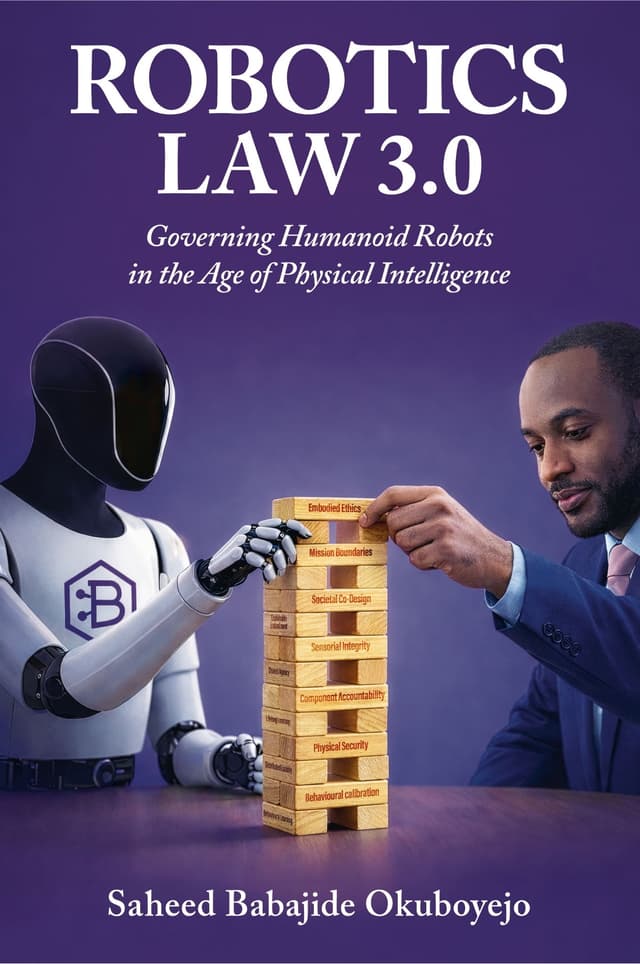
Cover of Robotics Law 3.0

Robotics Law 3.0

The Evolving Legal Framework for Humanoid Robots in the Age of AI

Robotics Law 3.0 arrives at a decisive moment in human history. More than seventy years ago, Isaac Asimov imagined a future where intelligent machines would walk among us, governed by simple laws designed to protect humanity. Those stories were fiction. Today, humanoid robots are no longer confined to pages or laboratories. They are lifting goods in warehouses, assisting clinicians in hospitals, supporting care in homes, and learning directly from human environments. Powered by advances in artificial intelligence, robotics has crossed a threshold where machines no longer merely automate tasks but act, adapt, and interact in shared human space. Yet while technology has accelerated, law has struggled to keep pace. Written by an international technology lawyer, Robotics Law 3.0 explores this widening gap and argues that we are standing at a rare intersection. Humanoid robots are becoming increasingly capable, yet global adoption remains early. This creates a once-in-a-generation opportunity to shape legal frameworks before norms harden, risks multiply, and trust fractures. The book contends that law should not merely react to robotics but actively guide its integration toward safety, dignity, and sustainable abundance. Blending law, engineering, ethics, economics, and geopolitics, the book introduces a new governance paradigm for embodied intelligence. It examines how humanoid robots challenge foundational legal concepts such as intention, consent, liability, and personhood. Through fictional storytelling, real-world case studies, global regulatory analysis, and original frameworks including the Twelve Pillars of Humanoid Robotics Governance, the book maps a practical path forward for policymakers, lawyers, technologists, investors, and business leaders. Crucially, Robotics Law 3.0 rejects dystopian narratives. Instead, it offers a hopeful, rigorous vision of coexistence, one in which thoughtful regulation accelerates innovation rather than constraining it, and where law becomes an enabling infrastructure for trust, adoption, and shared prosperity. As humanity moves from designing machines that think to machines that move, the question is no longer whether robots will shape our future, but how wisely we will govern their place within it. Robotics Law 3.0 is a foundational guide for navigating that choice.

Genres

LawTechnology

ISBN

9798902435501

Format

Print / Paperback

Contributor

Saheed Okuboyejo

Author

Saheed Babajide Okuboyejo is an international technology lawyer, author, and thought leader specialising in artificial intelligence, robotics, and emerging technology governance. He works at the intersection of law, innovation, and society, advising organisations, policymakers, and technology builders on how to deploy advanced systems responsibly across jurisdictions. With a background spanning law, business, and technology strategy, Saheed’s work focuses on the legal and ethical challenges posed by intelligent and autonomous systems that operate in real-world environments. His practice and research address issues including AI governance, robotics regulation, liability frameworks, human–machine interaction, and cross-border compliance in an increasingly automated global economy. Saheed is the founder of BabajideAI, a platform dedicated to advancing responsible AI governance through practical legal frameworks, tools, and education. He has advised startups, scale-ups, public institutions, and international stakeholders on navigating complex regulatory landscapes while enabling innovation. His work bridges common law and civil law traditions, drawing on global regulatory developments in Europe, North America, Asia, and Africa. As an author, Saheed is known for translating complex legal and technological concepts into clear, forward-looking analysis that speaks to lawyers, engineers, executives, and policymakers alike. His writing explores how law must evolve as technology moves from digital systems into embodied, adaptive machines that share human spaces. He approaches robotics and AI not as abstract technical phenomena, but as social forces that reshape labour, dignity, power, and governance. Robotics Law 3.0 builds on Saheed’s broader body of work on technology law and reflects his commitment to moving beyond reactive regulation toward adaptive, enabling legal systems. Rejecting dystopian narratives, he argues for frameworks that allow societies to harness intelligent technologies for sustainable growth and shared prosperity. Saheed Babajide Okuboyejo writes and speaks internationally on the future of law, robotics, and artificial intelligence. His work is guided by a simple conviction: that the most powerful technologies of our time demand not only innovation, but wisdom, responsibility, and law capable of rising to the moment.